
We’ve been celebrating our 30th anniversary all April long! Our birthday was just last Friday. As part of the fun, we’ve been meeting with former OVC Board members, and some others who have been along for the ride. We’re reflecting on three decades of tourism and considering what the future might hold. Join us for a look back on local tourism’s evolution, some Ottawa Visitors Center history, and a special guest’s unique perspectives.
This entry’s special guest is Lorraine McCallister, President of the Reddick Mansion Association. She got us started with some background on her work at the mansion.
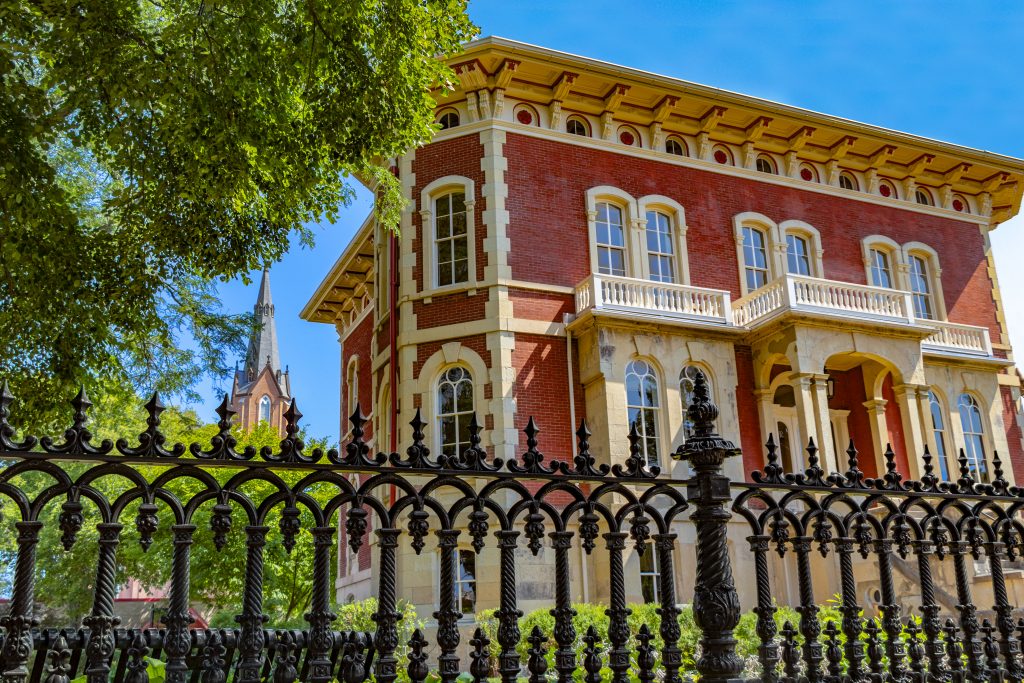
“I started here in 2013 as a one-day-a-week docent and gradually got more involved. And I was put on board, I believe, in 2015. And then in 2016 I was made president. And I’ve been president ever since. This is my tenth year. And a lot has happened in those ten years. We purchased the mansion from the city of Ottawa, from whom we had leased it since 1975, and underwent then, per the purchase agreement, a very large exterior restoration, which encompassed redoing all of the cornice work under the roof line, restoring, removing, restoring every single window in the building, every pane of glass was removed, the weights, the chains, everything were all put back. The weights are original to 1858. And then another major part was the complete restoration of the two iconic balconies on the south side and on the east side, whereby the balconies were completely removed, redesigned, and rebuilt. And that was at a cost of $1.4 million. Fortunately, we were able to stay open throughout the restoration, even though we were surrounded by scaffolding. The only time we were closed was when they were removing the asbestos caulking around the outside of the windows. But we were able to stay open for tours. We now outright own the building. We have satisfied the conditions of the purchase agreement. And since that time… We have put in a new boiler, affectionately called Buster. And we have also added air conditioning to the building. On the first two floors, it’s through mini splits because the walls here are solid, and there was nowhere to hide duct work for forced air conditioning. We do have forced air. Air conditioning on the third and fourth floors, Which has made a huge difference for us, because it was probably one of the best things we could have done here. Because it has made us much more comfortable for our summer tours, and particularly when it gets very hot and humid, and also has enabled us to host events in the summertime. As well as take in rentals, because before we were not able to do that in the summer. It was just too hot and uncomfortable upstairs. And so we have three rooms on the ground floor or the first floor that we rent out, and we also have three rooms on the second floor on the west side. Those rooms at one time were Mr. Reddick’s library and his office, and we have partially restored those rooms. But they are open enough for rentals and for us to host events up there as well,” Lorraine said.
“We also have, which I think is a huge undertaking, in the time since I’ve become president, two more bedrooms upstairs. When I started here, there was only one bedroom, Mr.Reddick’s bedroom, and the front hallway on the south side that were restored upstairs. And since then, we have restored both Mrs.Reddick’s bedroom and their adopted daughter, Elizabeth Funke, which has really enabled us to get a full tour of the mansion. The restoration was done, we hired a painter to come in, but the restoration was almost completely done by board members and a volunteer electrician. Our volunteers are a very valuable resource for us. We’re all volunteers here. None of us are paid to work here. I guess you would say it’s a labor of love. But, we purchased furnishings. We’ve… Just let it go. We have purchased furnishings for the bedrooms upstairs via auction. And I have a board member who is a master upholster. And she was able to do a lot of the window trim. And the window cornices for us. And so that saved us a lot of money. And the bedrooms are truly beautiful upstairs. They really are. Another purchase that we made that we’re very, very proud of is in the east center parlor.”
“It came to our attention that a set of original Reddick furniture was going up for auction. We knew where that furniture was located here in town. We could trace its provenance. It was sold after Mr.Reddick’s death in 1885. But we didn’t know it was going up for sale, going up for auction, until a friend of the mansion called. And it’s a beautiful set from the Jelliff Company, which was known for its high-end Victorian furniture out in New Jersey. And we knew the Reddick’s had a Jelliff set in their parlors. And so we went to the auction with $2,000 in cash and $6,000 in bids. And we were able to obtain all eight pieces for $7,750. And now they reside in a place of honor in the middle parlor upstairs. And so, plus we have hosted many events here,” she explained.
“For instance, the Radium Dial story is an integral part of Ottawa’s history, especially since it took place just kitty-corner across the street from us. And we’ve had Kate Moore, the author of kind of the preeminent book. It was published in 2017, but Kate was here for a book talk. Plus we have music concerts, other book talks, plus events. Christmas is always big here. Our volunteers spend around 250 hours decorating for Christmas. And so, plus we are open for tours on Friday, Saturday, Sunday, and Monday. And we realized that we could only give really two tours a day to encompass the whole story and to view the whole mansion. And those are at 11 o’clock and 1 o’clock.”
“And also this year, we have revamped our website. And we now are able, people are able to reserve their tour tickets online, which they were not able to do before. So they could call in or email. But now they can do it and pay for it online. We’ve also updated our system in the office. We have the square now to take care of all of our transactions, both with tours, gift shops, donations, etc. And so we are very busy here. We had, I think last year, We had people from 35 different states and 10 countries. And that kind of encompasses, I think, what we’ve done since I started here,” Lorraine said.
Ottawa’s rich history continues to be a draw for tourists all over. The Reddick Mansion is a place where you can feel like you’ve taken a step back into the past. We’re always happy to recommend it as a place to stop for any history enthusiast. Next, we asked Lorraine what Ottawa tourism means to her.
“For us, it’s everything. It’s everything. Because that’s what we rely on just to pay the bills. We rely on people coming in and taking our tours or coming from even out of town to attend our events. That’s everything for us. Because that’s our purpose … In years past, when the Reddick Mansion Association started here, after the library left, they rented out rooms to different organizations and agencies, and that’s primarily how they made their money, and they restored one room. Well, then through the years as those agencies left, the board decided, long before I started, that we need to change our plan here and go to more restoration and then opening it up to the public for tours. And it’s been slow, but since then, that’s what we rely on to pay our bills, to keep the electricity on. Are the people that come in for our tours, plus memberships, and everything, and our donations. But, we rely totally on tourism, people coming in from out of town. We get a lot of people. I keep track of the statistics, monthly statistics, and every month most people come here from greater than 50 miles away, by far, by far. And some, and then we ask too, you know, are you in town for the weekend? Are you just here for the day? The majority of them are day trippers. I know the goal is ‘heads on beds.’ But we’re very fortunate to have Starved Rock Lodge nearby, and the, Kishauwau cabins, postcard cabins, Camp Aramoni, those unique places that have opened up. And Heritage Harbor has been a help in bringing people in. We’ve had a number of people come through here that are staying at Heritage Harbor that are doing the big loop, through the Great Lakes and St. Lawrence Seaway down the coast, and through the Gulf and then up the rivers again… So tourism, we definitely rely on it. And it has grown. The number of people coming to town has definitely grown,” she said.
And grown it surely has! Throughout these interviews, many people have pointed to the drastic change in local tourism as a response to downtown revitalization and other beautification efforts. With this in mind, we asked Lorraine how she has seen tourism change over the years.
“I was raised here in Ottawa and educated here, but then I was away from here for 34 years, and then came back in 2012 when I retired, and started here in 13. But here, our visitors have increased exponentially since I started keeping records. We didn’t have very good records before that. But the pandemic, of course, hurt. And that was what shut us down, not the restoration, but the pandemic. I think especially with the change in the use of media has definitely made a big difference. We are no longer relying solely on the print media. We now can go online and the Facebook, and all of the various social media aspects that you can tap into. And I think there is a lot more also cooperation between the various entities in town. And Ottawa has also pushed hard to make Ottawa an appealing place to come. In terms of the street scapes, which I know some people think are a pain, but the street scapes, the lights, the lights downtown, our Chamber of Commerce is wonderful in encouraging businesses to come to Ottawa,” Lorraine said.
“The Visitor Center is wonderful in terms of promoting events and sponsoring events like the Morel Fest, the Kites and Flight. Those are such unique events that pull lots of people into town. It’s wonderful. And I think the city has become more cooperative. It depends on kind of the people on the council. It kind of ebbs and flows through the years, particularly who your mayor is. And most of our mayors have been very encouraging of helping to sponsor events and bringing people into Ottawa, making them want to come.”
“There are 17 of us, historic entities in LaSalle County have started meeting quarterly. Like the Seneca Museum, Mendota, Earlville, Leland, Norway. Peru, the Hegler-Carus Mansion, the Ottawa Historical and Scouting Museum. We meet quarterly, and we share what are we doing, what is working for us, how can we work together. We have also been working with IVCC in the last two years. We have taught there in the continuing education parts catalog for IVCC. And we have been teaching classes in the fall. We’ve had about, eight or nine sessions the last two falls. And we cover various aspects of LaSalle County history. I did a program called Three Blocks in Time, and I talked about the debate, the mansion, and the Radium Dial. I also have done one on the Lincoln-Douglas Debates. And any town that can claim Lincoln as a significant figure in its history is vitally important… The Scouting Museum has their lecture series, which I think is wonderful. I have done a lecture every year for them. Again, just to highlight the rich history that Ottawa has, and to make people aware of what we have right here. To make people want to come. And I have, I know your contact with WGN has been vitally important.”
“I’ve had several people just recently call and tell me, I listen to WGN and I’ve heard so much about Ottawa and would like to visit. And so that kind of outreach is wonderful as well, that partnership. Has worked very well. I also participated in the program at IVCC, and I did it on the Lincoln-Douglas Debates, all seven of them, and of course Ottawa was the key focus. And that was a collaboration, it was a program offered to five different junior colleges, where people, it was all Zoom. I had about 35 people that joined. So, any kind of programming we can do that gets our name out there. I just did a program last weekend at Starved State Park on the early pioneers of LaSalle County. And of course, all of my focus is mostly history based. Just because of the nature of our place here,”
“And I just see a lot more collaboration, I think in the internet since I started here, especially, which I think is huge. Our ultimate goal always is to bring people to town. I think it’s important for us to work together,” she said.
Working together is what helps make local tourism work. Collaboration allows us to support the very places that make Ottawa such a special town. When we work together, areas of local interest like the arts, history, local businesses, and more can succeed. This is especially apparent when it comes to events. We asked Lorraine if she has a favorite event or attraction in Ottawa.
“I’m glad to see [and] I want one to continue, and that’s the Chris Kringle market. If possible, because that does bring in people from out of town, for sure. And it’s interesting that this is going to be held only at the Jackson Street. The Morel Fest I know Donna brought back, which is wonderful, the Kites in Flight, of course, that’s dependent on the weather, but it’s been very successful. I don’t think they had it last year, The Touch a Truck. They used to have the Taste of Ottawa and all of that. The Wine and Lobster Fest was very popular. And you wouldn’t necessarily have to serve lobsters. That’s pretty high end. But I think a lot of people do like jazz, and I think that a festival like that, I think would be good for Ottawa. I like a variety, something that would appeal to adults, something that would appeal to children. I know they have, like this year, instead of the Friendship Days/River Fest, that has been kind of irregular, it used to be a week long, and things have to change, I understand that. We used to have a drum and bugle car competition, because we had one here. We used to have the huge parade. But if anything, push a variety of things that appeal to adults and to children.”
“This year, we’re not having Riverfest, per se. We’re having debate days instead. And we are somewhat involved with that. We’re going to have a tea here with Mrs. Douglas, Mrs. Lincoln. And the committee is working well together for that. Definitely keep music in the park. I like the fall festivals that they have. There used to be the Scarecrow Fest, and then there is another one. But, well, and the 4th of July, bless the Ottawa Downtown Association, that they picked up from Ottawa First the 4th of July, to keep the fireworks. I know it’s tough to get volunteers. It is tough to get people to commit. And that is a downside to a lot of these activities that you want to plan. It is a downside. I understand it’s hard to get volunteers here. But anything that will bring… The Wine and Jazz Fest, I know, people really enjoy. Leave the lobster out of it… And so the Third Friday Market on Madison Street, that is a beautiful idea, wonderful idea to bring people downtown and everything,” Lorraine said.
“If anything, just develop a spirit of cooperation and collaboration, which I think is vitally important to the people in town, the entities in town that work tourism as part of their trade. If anything, then we can help the people downtown, by bringing folks to town and the restaurants.”
With history, arts, nature, and more, Ottawa truly is the Middle of Everywhere. All of these working parts that Lorraine mentions, help contribute to the charm and identity of the city. That’s what will keep encouraging people to visit! To close out our interview, we asked Lorraine if she had any final thoughts on the future of tourism and Ottawa.
“I like the fact that, like with LaSalle County, I’ve not partaken of it myself, but I know with the tourism coalition with the county, you can get the, billboards and social media posts and things like that, which I think are great. Any means of increasing our recognition, increasing our people knowing about us is wonderful. And our tourism dollars are kind of hard to come by. Because tourism dollars, well, let’s face it. Let’s say at a school, when you’re looking at cuts, what are the first things to go? The fine arts or the industrial arts. But usually the fine arts are the first to go. Well, tourism is kind of the same way. And I just wish the people would realize that, hey, tourism can help a town. Look at Streator, they got their grant for it. They’re trying to bring people into town. If I would do anything, I would, and I know they’re trying to get more volunteers to keep the street scapes neat and clean. I know you guys are doing a great job.”
And I know I’ve had a couple of calls here from people. And they’re coming to town for a couple of days, ‘What are the other, what are other things to do?’ And I will tell them, ‘I would strongly advise that you stop at the Visitor Center first. And they will be able to help you, and I’ll give them the phone number. One lady, I told her, ‘Why don’t I give you the phone number, call them, and I’m sure they would be able to help you and guide you with places to go and things to do in the city,” Lorraine said.
“We are very fortunate in this area that we have the state park system that we do, and that Allen Park has been redone. Ottawa, considering its limitations, has done a beautiful job with Allen Park and the parks around us. And the new swimming pool. Does it bring in tourism? No. But hey, it’s great. I love it. The new Y. I think Ottawa is progressing.”
Many thanks to Lorraine! We’re so proud to work with this community, and so thankful for 30 years in the Middle of Everywhere. We have a few more interviews for you left! Stay tuned on the rest of our blog or our Facebook page for the last of this series.