
We’re celebrating an important milestone soon. The Ottawa Visitors Center is turning 30 years old on April 24th. As part of the celebration, we’re launching a series of interviews with some of the people who have had a hand in developing tourism in Ottawa throughout the years. We’re hoping to feature past and present OVC Board members, former staff, city workers, and more.
Our first interview is with Nancy Stisser, who many might recognize from City Hall. She has served as the Events Coordinator and Administrative Assistant to the Community Development Department at the City of Ottawa, as well as a City Representative on the OVC board. She told us about her time with the City of Ottawa, tourism’s evolution in Ottawa, and more. First, we discussed more of her local background.
“I basically have lived in Ottawa all of my life. I was born in Morris, but my parents lived in Ottawa. So, Ottawa is my hometown and I have been involved from the economic point of not only living here, but I also had my first job in Ottawa when I was hired at Famous Department store, which is now Jeremiah Joe’s and so on,” Nancy said.
After that, Nancy told us about her history with the City of Ottawa.
“Following the partial raising of my children, once they got into the grade school system, I was hired at the City of Ottawa City Hall Site, to fill in for a job for two years. That was going to be changing, and they just needed somebody temporarily. As it turned out,” Nancy said, “At the end of that two years, they needed somebody full-time, and asked me to stay. So on that particular situation, I just recently retired after 38 years, so I’ve seen a lot in Ottawa. Not only as a resident and a parent of children in the school system, but also as an employee of the City of Ottawa.”
“I served for five mayors, each of whom, of course, had their own agenda and/or their favorite causes. Some were more interested in beautification. Others might be more interested in outdoor work. There’s people that were innovative and others that were traditional, but it’s been quite an interesting journey to follow through, with what preferences were and is the city changing in a positive direction or by the same token, remains the same,” she said.
Nancy recently joined the team at the office and we have already learned so much from her. As mentioned above, she served on the OVC Board. She explained her duties during her time on the board.
“At the meetings, I would represent the city and then report back to the mayor and others who were interested in what was taking place, what plans they might have, events coming up, questions, issues, innovative ideas. The middleman, so to speak.”
Taking these years of experience and knowledge into account, we wanted to ask Nancy what tourism in relation to Ottawa means to her.
“I’ve always felt that tourism maybe isn’t exactly the right word? There should be a different word to describe people that come to Ottawa for specific reason. Other than ‘sightseeing.’ I think the majority of the people that come to Ottawa are passing through, and they stop by, or they have family here, or working with the city.”
“I found a lot of people that moved back to Ottawa because they were born and raised here, and they want to get away from the effects of overpopulation, and that wouldn’t be considered tourism, but yet it may be as they work up to that point, of deciding to move back to Ottawa. Personally, I don’t know that there’s any one big draw that I would consider Ottawa as a tourism community. It’s not like something maybe makes a drive to Chicago to see the bean or a specific museum that is well known.”
“Starved Rock probably is the biggest draw, and I would imagine that that would probably be the biggest tourism draw that has remained consistent over the years. Because it is located so near to Ottawa. Ottawa seems to be, from what I’ve been able to tell over the years, the best access to Starved Rock from the Northeastern the suburbs, coming in through Ottawa, so tourism by way of getting in route The Starved Rock location. Ottawa does get tourism in that direction.”
In the spirit of celebrating an important milestone with our thirtieth anniversary, we asked Nancy her thoughts about how tourism in Ottawa has changed and evolved over the years.
“The reasons for people coming to Ottawa as tourists, I don’t think the reasons have changed all that much. However, a lot of the reasons that people come to Ottawa as a tourist have been accelerated because of the promotion that our current and recently, interested people in the governmental offices about promoting Ottawa. So, people still come to see Starved Rock. They still come perhaps to see WD Boyce Memorial, the downtown area, the Ottawa Boat Club, Allen Park, anything that has been here for a long time.”
“The promotion that’s done by, not only the Visitor Center, but the City of Ottawa, has increased and given the word tourism a new spin, and it’s more exciting, mobile. Things have always been here, but not nearly as well promoted, as they are currently.”
“The other option to include, as far as the increase in tourism, is the number of events that have been created in the last 10 or 12 years. New events or a spin on an existing event that is handled a little differently, or new things to do. But the the new events, particularly in the downtown area, that are being created to encourage people to come to Ottawa certainly increased. I can’t even begin to imagine, what percentage of new events there are, versus once long-standing.”
While on the subject of events, we asked Nancy if she had a favorite local event, past or present. She discussed the initial iterations of a longtime local favorite.
“Mine goes back a long way, and for a lot of reasons, as almost a very emotional one… it’s the Festival of Lights Parade, the night after Thanksgiving. That just is the most outstanding thing that I’ve ever seen two people put together. To this day, it fills my heart.”
“When I remember Don and Betty Gillette creating something that Ottawa could use, and it was a gift from them, to the city of Ottawa. It was indeed inclined to be something that, we really have a struggle these days, of working with a large group of volunteers. Volunteers, I think this day, are a little harder to find. People are more busy and the times have changed,” Nancy said.
“But back in those days when they created this parade, Betty was very adamant about the fact that there was to be no advertising. The parade should not last any longer than 30 minutes, and the parade was for the children,” she said. “They built floats in their own home. Their families, their children, then as the children grew, their children all pitched in and helped put together this gift to the city of Ottawa. That was touching. The love for your community and wanting to do it for the children and no one was going to gain anything from it. It was wonderful for the children and the soul.”
“The hundreds of hours and hundreds of people it takes to put it together was a the biggest true love of a community I’ve ever seen… And that was their gift of the city, and I will never forget what a wonderful experience that was.”
“And it’s unfortunate that sometimes people take something that’s perfectly fine the way it is and change it. That’s one thing that I feel that was almost perfect the way it was. The children only have a certain amount of attention span time span, usually the the weather is questionable. Parents, out of the the love of their own children, would come out on the coldest of nights, in rain ,snow. No matter what the weather was like. Very respectful of the occasion and very grateful.”
“And of course, everyone waits for the end to see Santa. And Santa was always so nice to be able to come and join us at the end of every parade,” Nancy said. “It was the epitome of the Christmas spirit.”
We also wanted to ask Nancy if she had a favorite past or present attraction or location in Ottawa. Perhaps either of these places could be the spot you explore the next time you’re in town! Plus, you’ll have some interesting historical knowledge behind these locations, that others might not know.
“The one is something that is visible now, and that’s Allen Park. It may sound rather uneventful, but I have a clipping from the Times newspaper. I believe it was 1953, of my father running a piece of equipment. He was an operating engineer, and he was the first person to break ground when they started cutting into the Allen Park property, to turn it into a park,” Nancy explained.
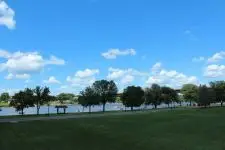
“The park really hasn’t changed. It’s improved. And it’s larger, but the main purpose of the park has remained the same. It’s a wonderful place to get away, a very passive area. You can sit down. You can sit in your car. You can sit along the riverbank. There’s playground equipment. It’s a wonderful time just to relax and enjoy nature. You don’t have to pay to get in. There’s not a time limit, besides the exception of opening and closing,” Nancy said. “You can just enjoy the atmosphere of Ottawa. The hustle and bustle of people going over the river on the bridge really doesn’t interfere with that very calming effect that it has.”
“So in all these years… it’s been the reason for it. The upkeep has not only stayed the same, they’ve improved, but it’s remained just exactly what it was intended to be. Nobody’s changed it, except for the better. For improvements, new playground equipment, and maybe shoring up the riverbank, and boat docking.”
“But it’s just a wonderful place, for all ages to be able to enjoy, and enjoy together. Great place for picnics, and that hasn’t changed. It remains one of my favorites, having been here for so long,” she explained.
“The other is more personal. To the extent that there’s no way of sharing with people the difference, but that’s Fox River Park. In 1999, when the city had the opportunity To get involved with State agencies for what we referred to as a buyout program, That area was known as The Flats,” Nancy said.
Nancy told us the area was referred to as “The Flats” due to its low-lying position in relation to nearby areas. The area flooded often, leading to extensively damaged structures and unsafe conditions.
“And today we still call it The Flats. The project ended up being an incredible success. And when I drive by there now, and I see people enjoying the acreage, the park atmosphere, see the calmness versus what it was so many decades ago, where houses had been abandoned, misuse of the residential situations, in some instances. The buildings were left decay, or lose meaning, purpose. A garage that was abandoned, or a large home that was turned into apartments,” she said.
“And in turn, it brought in unseemly characters. It was a place that you really didn’t want to be, but the people that lived there, that was their home. And they did the best that they could, with what they had. With the flooding, it was something that they were used to, and they loved living by the river, and I can appreciate that.”
“But when it came time, to offer them the opportunity to leave, some people just didn’t want to leave. That was very difficult. To watch them finally succumb to the fact that their value of their home was never going to get any better, and this would be an opportunity for them to move on. Very difficult for some and a relief for others,” Nancy explained.
She told us some of the stories of the people who had formerly lived in the area. The first regarded someone who had initially not wanted to move away from the location, but eventually decided for it was for the best.
“That was the culmination. It ended up a futile effort to be able to stay. She was in tears because they decided to go ahead and participate in my program, how they did as everyone else. They’ve gotten a fair, fair market price for their homes. She was in tears, saying she hated to leave, but she couldn’t stand the thought of leaving her house by boat one more time. And it was a very emotional for them. They’d raised their children there,” she said.
She also told us the story of a woman who had a salon business in her home in the area.
“They had a rope swing that someone had put up for a young grandson, And it bothered her so much, not only to leave the house and the business that she had for some 30 or 40 years, but that rope swing she was going to have to leave behind. And her grandson just didn’t really understand why they were leaving…”
“Life has a way of having you run into people that are so nice and so kind, and remind you of human nature. We had a contractor that volunteered to take that swing down… delivered it to the family that had moved. And that was a picture that I took and treasure, of her and the grandson holding the rope swing in their new yard,” Nancy explained.
“That’s why Fox River Park has so much meaning, because we were able to see 60 residences that were in poor condition, and repeatedly damaged by flooding, and families that needed an opportunity to move on and to move into a situation where it was healthier and safer. And a better environment for them. Probably the only opportunity they ever would have had.”
So, now when you go by Fox River Park, I remember all of those people. Some have passed, and others have moved on, relocated, and made their new homes. But I remember the memories there and how many families are so much better off, because of what several agencies and a lot of people who were willing to work with, change their lives. And now the people that come down there have no idea what it used to look like, or what it was, or all the sad stories that came from the families that lived there.”
“It turned into a beautiful place, its peaceful and quiet.”
Here in the Middle of Everywhere, history can be right beneath your feet and you might not even know it. We’re so grateful for Nancy taking the time to speak with us and tell not only her story, but the story of Ottawa and its people. We decided to close the interview by asking Nancy if there’s a previous event or some sort of revitalized attraction she would like to see return to Ottawa. She shared her insight with us.
“I don’t want to offend anyone, I’m not thinking of anything at this particular time that you could do. For the main reason that I know that I’m certainly beyond retirement age, so as an older person, the things around here aren’t any different than they are anywhere else. They’re not the same. People are not the same. The economy is different. You can’t do a lot of the things you used to. It would be nice, but in all good conscience you cannot do it,” she said.
Nancy expressed that people in Ottawa generally seem comfortable with the atmosphere that has been created over the years, citing how the population hasn’t changed too dramatically. In reference to existing events and attractions, Nancy said,
“I don’t know that you could do much better.”